Quick Answer
A Jyotirlinga is a sacred shrine where Lord Shiva is believed to have manifested as an infinite pillar of divine light (jyoti). According to Hindu tradition, there are twelve Jyotirlingas spread across India. These temples are among the holiest pilgrimage sites for Shiva devotees and symbolise the limitless and eternal nature of the Divine.
The Story
The word "Jyotirlinga" comes from two Sanskrit words: "Jyoti" meaning light and "Linga" meaning symbol or mark. Together, Jyotirlinga means "the symbol of the divine light of Shiva."
The origin of the Jyotirlingas is described in the Shiva Purana and the Linga Purana. According to this sacred tradition, a dispute once arose between Lord Brahma and Lord Vishnu over who was supreme. At that moment, Lord Shiva appeared as an endless pillar of brilliant light that stretched beyond heaven and earth. Brahma flew upward in search of its top, while Vishnu journeyed downward to find its base. Neither could discover its beginning or end, realising that Shiva's true nature was infinite and beyond human comprehension.
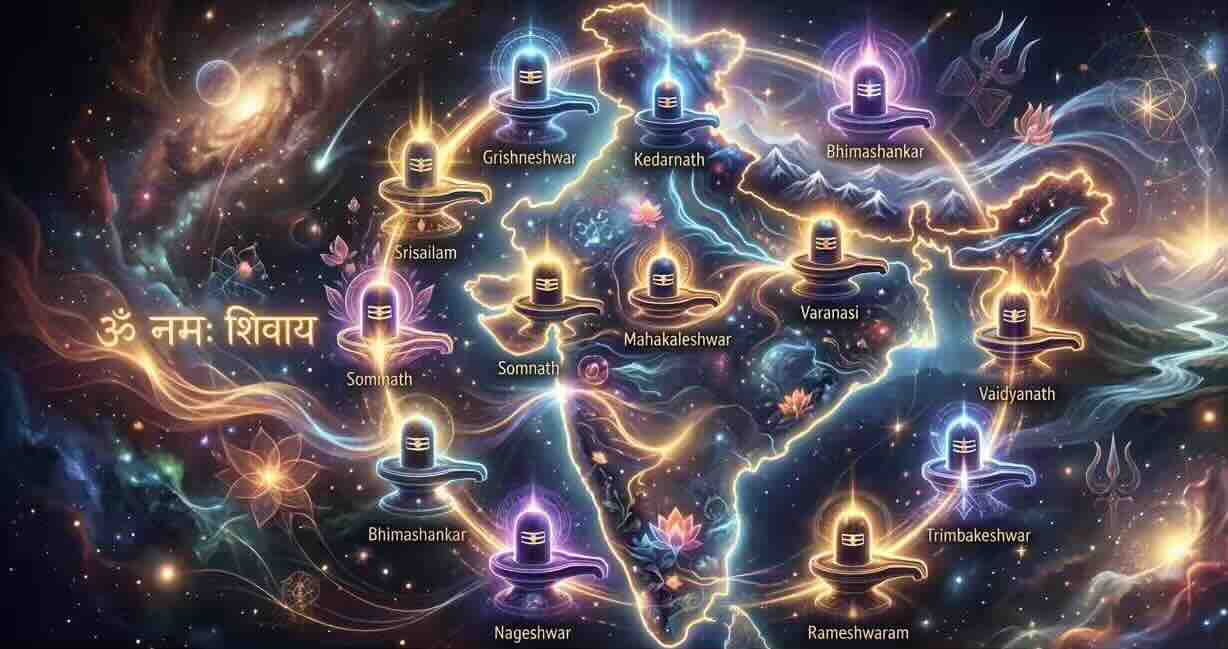
This divine light later manifested at twelve sacred locations across the Indian subcontinent, where Shiva is worshipped as a Jyotirlinga. Each temple is associated with its own legend, local traditions, and historical development.
- Somnath, Veraval (Gujarat)
- Mallikarjuna, Srisailam (Andhra Pradesh)
- Mahakaleshwar, Ujjain (Madhya Pradesh)
- Omkareshwar, Khandwa (Madhya Pradesh)
- Kedarnath, Rudraprayag (Uttarakhand)
- Bhimashankar, Pune (Maharashtra)
- Kashi Vishwanath, Varanasi (Uttar Pradesh)
- Trimbakeshwar, Nashik (Maharashtra)
- Vaidyanath, Deoghar (Jharkhand)
- Nageshwar, Dwarka (Gujarat)
- Rameshwaram, Rameshwaram (Tamil Nadu)
- Grishneshwar, Ellora (Maharashtra)
Did You Know?
- The Somnath Temple in Gujarat is traditionally listed as the first of the twelve Jyotirlingas.
- The twelve Jyotirlingas are located across several Indian states, reflecting the widespread devotion to Lord Shiva.
- Many Jyotirlinga temples have been rebuilt multiple times throughout history while preserving their sacred traditions.
- The complete list of the twelve Jyotirlingas is mentioned in the Dwadasha Jyotirlinga Stotram, a devotional hymn attributed to the philosopher Adi Shankaracharya in later tradition.
Why It Matters
The twelve Jyotirlingas continue to attract millions of pilgrims every year. Visiting these shrines is regarded as an act of deep devotion rather than a religious obligation. Festivals such as Mahashivaratri and the holy month of Shravan see especially large gatherings of devotees.
Beyond pilgrimage, the Jyotirlingas represent a timeless spiritual idea: that the Divine is infinite and formless, and it is present everywhere. They also preserve centuries of Indian temple architecture, regional traditions, music, rituals, and cultural history.
References
- Shiva Purana, Kotirudra Samhita (translated editions by J. L. Shastri, Motilal Banarsidass).
- Linga Purana (translated editions by J. L. Shastri, Motilal Banarsidass).
- Dwadasha Jyotirlinga Stotram (traditionally attributed to Adi Shankaracharya).