Quick Answer
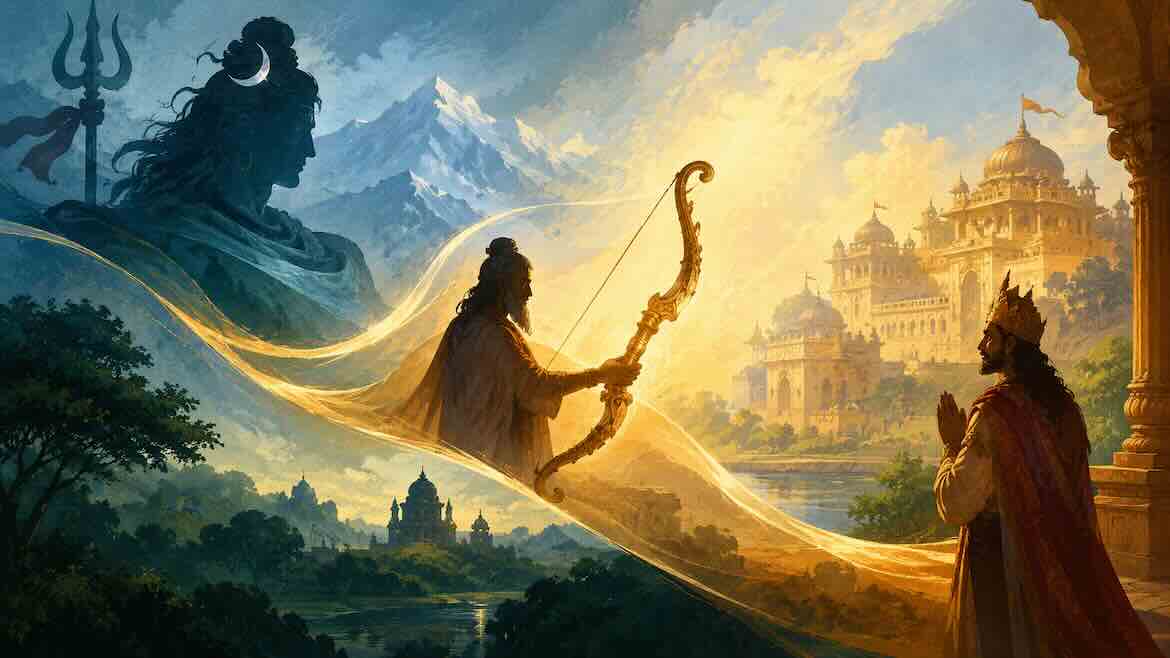
According to the Valmiki Ramayan, Shiva's mighty bow came to Mithila through King Devrat, an ancestor of King Janak. During the destruction of Daksha's sacrifice, Shiva became furious with the gods and raised this bow against them. When the gods later pacified him, Shiva gave the bow to them. The gods then entrusted it to Devrat, the sixth king in the lineage from Nimi. The bow was preserved by the kings of that lineage and eventually came into the possession of King Janak.
The Story
The story of Shiva's bow begins with Vishvakarma, the divine architect. According to Parashuram's account in the Valmiki Ramayan, Vishvakarma created two extraordinary bows. One was given to Shiva, and the other to Vishnu. Both were immensely powerful and were regarded as exceptional among divine weapons.
Shiva's bow was associated with the destruction of Tripurasur, while Vishnu received the other divine bow. Later, the gods wanted to know the relative strength of Shiva and Vishnu. At their request, Brahma brought about a confrontation between the two. During this great contest, Vishnu's power caused Shiva's bow to become motionless. Seeing this, the gods and sages regarded Vishnu as superior in that particular contest.
Shiva became angered by what had happened. He then gave his mighty bow, along with an arrow, to Devrat, the renowned king of the Videha lineage. This is the crucial moment that explains how the bow eventually came to Mithila.
Janak later gives another part of the bow's history when Vishvamitra asks him to show it to Ram. He explains that Devrat was the sixth king in the lineage from Nimi, the ancient founder of the Videha line, and that Shiva's bow had been entrusted to their ancestor as a sacred trust. Janak also recalls that during the destruction of Daksha's sacrifice, Shiva had drawn this very bow and confronted the gods in anger. When the gods later pleased Shiva, he gave the bow to them, and they entrusted it to Devrat.
Thus, the bow's journey can be traced as:
Vishvakarma → Shiva → the gods/Devrat → the kings of Videha → King Janak.
It was therefore not merely an ancient weapon kept in Mithila. It was a divine heirloom preserved by the Videha royal lineage for generations.
Did You Know?
In the Valmiki Ramayan, the bow is described as the "jewel of bows" belonging to Shiva. Janak also tells Vishvamitra that earlier powerful kings had been unable even to move it when they came to test their strength.
Why It Matters Today
The story reminds us that inheritance is not always about ownership. Sometimes an heirloom represents a duty to preserve something received from previous generations.
For the kings of Mithila, Shiva's bow was not merely a weapon. It was a reminder of their ancient lineage, their connection with the divine, and the responsibility of protecting what had been entrusted to them.
References
- Valmiki Ramayan
- Bal Kand, Sarga 66, verses 7-13: Janak explains the history of Shiva's bow, Devrat's connection to it, and how the gods entrusted it to his ancestor.
- Bal Kand, Sarga 66: the account of Shiva, the destruction of Daksha's sacrifice, the gods' appeal to Shiva, and the transfer of the bow.
- Ramcharitmanas
- Bal Kanda: contains the later narrative context surrounding Shiva's bow, particularly the Dhanush Bhang and Parashuram episodes. The detailed transfer of the bow to Devrat is most clearly stated in Valmiki's account.