Quick Answer
Gujarati people perform Garba during Navratri to honour Goddess Durga and celebrate the victory of good over evil. Traditionally danced in circles around a lamp or an image of the Goddess, Garba symbolises life, divine energy and the cycle of existence. It is also a way to preserve Gujarati culture and strengthen community bonds.
The Story
Navratri means "nine nights" in Sanskrit. The festival honours the Divine Feminine, worshipped in forms such as Durga, Amba and other manifestations of Shakti, the divine power associated with creation and protection.
Goddess Durga fought the buffalo demon Mahishasur and defeated him after a fierce battle. Her victory represents the triumph of good over evil. Across India, Navratri is observed through different regional customs, and in Gujarat, devotional singing and Garba have become defining features of the celebration.
The word Garba is commonly associated with garbha, meaning womb. A traditional Garba lamp, often placed inside a perforated earthen pot called a garbo, represents life and divine energy. The dancers move in circles around it, symbolising the cycle of life and the enduring presence of the divine. The lamp's light can also be understood as a symbol of knowledge and hope.
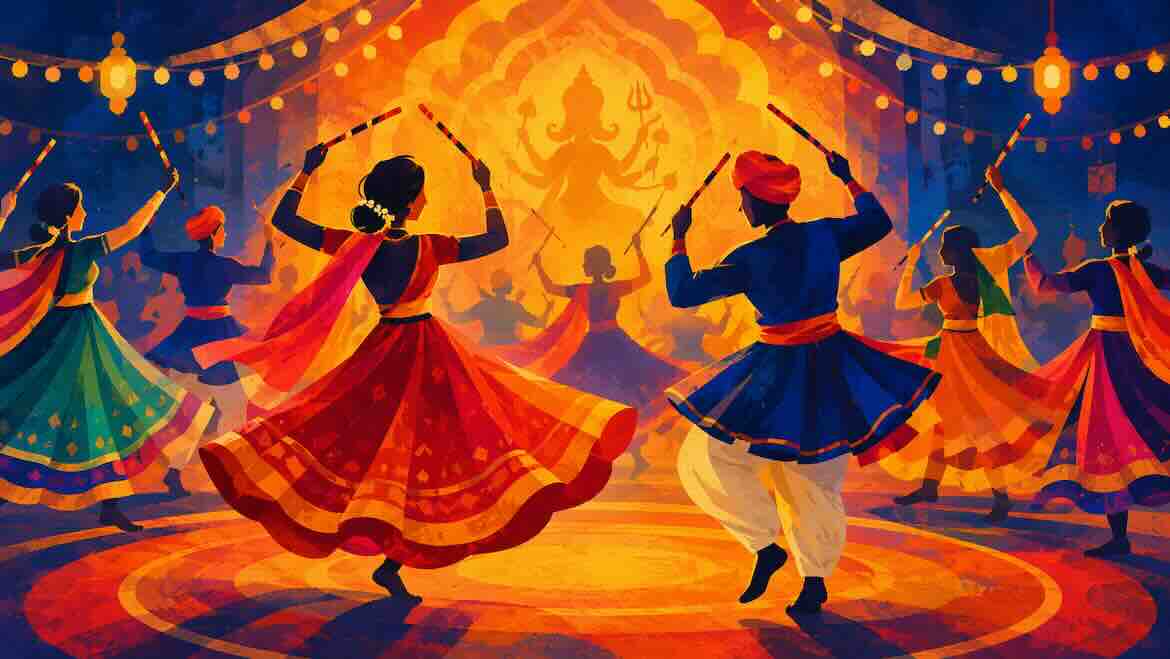
Garba traditionally takes place in the evening, after prayers and worship. Dancers form circles and move rhythmically to devotional songs dedicated to the Goddess. The steps may appear simple, but the coordinated movements create a shared rhythm in which everyone can participate.
Over time, Garba has evolved. Traditional folk songs and instruments now accompany modern arrangements, and colourful chaniya cholis, kediyus and other festive clothing have become familiar sights. Dandiya Raas, another popular Gujarati dance, is often performed during the same celebrations. Although the two are frequently grouped together, Garba and Dandiya Raas have distinct dance styles and traditions.
Did You Know?
- A lamp at the centre: Traditional Garba may take place around a lamp inside an earthen pot, symbolising life and divine energy.
- Garba and Dandiya are different: Garba usually involves rhythmic circular movements without sticks, while Dandiya Raas features pairs of dancers striking decorated sticks together.
- A global celebration: Gujarati communities have helped Garba become a familiar Navratri tradition in countries around the world.
- More than a dance: In 2023, UNESCO inscribed Garba of Gujarat on its Representative List of the Intangible Cultural Heritage of Humanity.
Why It Matters
Garba shows how a cultural tradition can keep faith, identity and community connected across generations. People learn songs and dance steps from family and friends, while public celebrations bring together participants of different ages and backgrounds.
Its circular movements also offer a powerful image of unity: everyone contributes to a shared rhythm, and no single dancer needs to stand at the centre. For Gujaratis, Garba is not simply a dance performed during Navratri. It is a living expression of devotion and belonging.
References
- UNESCO: Garba of Gujarat, Representative List of the Intangible Cultural Heritage of Humanity, 2023.
- Devi Mahatmya (Durga Saptashati): Chapters 2-4, describing the battle between Goddess Durga and Mahishasura.
- Markandeya Purana: The text containing the Devi Mahatmya, including the account of the Goddess's victory over Mahishasura.
- Ministry of Culture, Government of India: Resources on Indian folk traditions and cultural heritage.