Quick Answer
Krishna's birth is celebrated at midnight because the traditional birth narrative places his appearance at the dead of night, in the prison of Mathura. The Bhagavat Purana describes this as the moment when Vishnu appeared as Krishna, while the Harivamsh Purana gives the timing more specifically as the eighth day of the dark fortnight, with Rohini rising at midnight.
That is why devotees observe Janmashtami through fasting and prayers, waiting until midnight to celebrate Krishna's birth.
The Story
The story begins with Kansa, the powerful ruler of Mathura. As he was taking his sister Devaki and her husband Vasudev home after their wedding, a divine voice warned him that Devaki's eighth son would cause his death. Enraged, Kansa initially tried to kill Devaki, but Vasudev persuaded him to spare her and promised to hand over every child they had. Kansa initially accepted this and even spared their firstborn. Later, after Narad revealed the larger divine plan surrounding Krishna's birth, Kansa's fear turned into paranoia. He imprisoned Devaki and Vasudev and began killing their newborn children, determined to prevent the prophecy from coming true. He killed their first six children.
The seventh child, Balram, was mystically transferred to the womb of Rohini, another wife of Vasudev, who was living safely in Gokul under Nanda's protection. People in Mathura believed that Devaki had suffered a miscarriage, while Rohini later gave birth to Balram. Because he was "drawn" from one womb to another, he came to be known as Sankarshan.
Then came the eighth pregnancy.
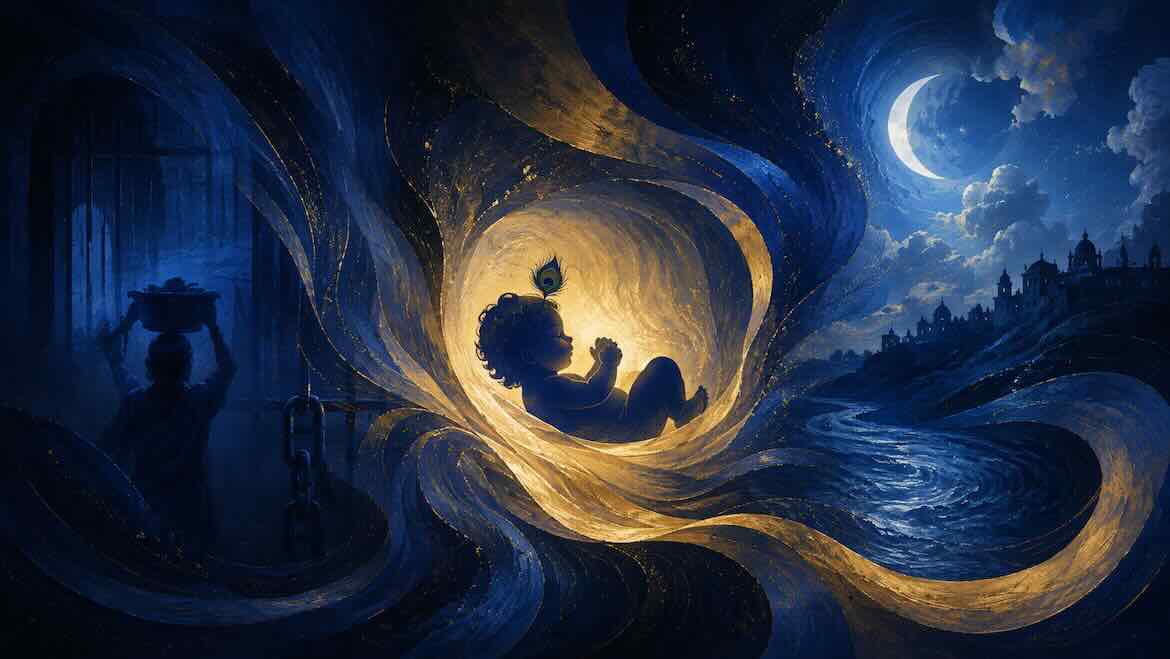
On the appointed night, Devaki gave birth inside the heavily guarded prison. The Bhagavat Purana describes the entire universe as becoming peaceful and auspicious. At midnight, Vishnu appeared before Devaki and Vasudev in his divine four-armed form, carrying the conch, chakra, mace and lotus.
Vasudev was instructed to take the newborn across the Yamuna to Gokul and exchange him with the newborn daughter of Yashoda. Miraculously, the prison guards fell asleep, the restraints opened, and the prison doors gave way.
Vasudev carried Krishna through the stormy night. The Yamuna, swollen with rain, became part of this extraordinary journey, and Vasudev eventually reached Gokul. There, Krishna was exchanged for Yashoda's newborn daughter, who was brought back to the prison.
When Kansa tried to kill the baby, she escaped his grasp and revealed herself as a divine power, warning him that the one destined to destroy him had already been born.
Thus, midnight is not merely a convenient time for celebration. It is the very hour at which the traditional narrative says Krishna appeared in the world.
There is also a deeper symbolic reading. Krishna appears when the world around him is covered in darkness, yet his arrival brings hope and restores the possibility of dharma. This connects naturally with Krishna's later teaching in the Bhagavad Gita that the Divine manifests when dharma declines, and disorder rises.
Did You Know?
- The Bhagavata Purana specifically describes Krishna's appearance at midnight in its Tenth Skandha, Chapter 3.
- The Harivamsh gives a more detailed astronomical description, associating the birth with Krishna Paksha Ashtami and Rohini at midnight.
- Different regional calendars can call the lunar month Shravan or Bhadrapad, which is one reason Janmashtami dates can vary by tradition and location.
Why It Matters
The midnight celebration keeps the story alive in a powerful way. Devotees do not simply remember Krishna's birth. They wait for the moment.
The darkness of midnight becomes a reminder that difficult periods do not last forever. Krishna's story begins in a prison, under threat and surrounded by uncertainty, yet that very night marks the beginning of Kansa's downfall and a new chapter in the story of dharma.
References
- Bhagavat Purana
- Skandha 10, Chapter 3, especially verses 1-10: Krishna's auspicious birth, his midnight appearance and his divine form.
- Harivamsh
- Vishnu Parva, Chapter 59 in the traditional English translation: birth of Krishna and Balram, including the midnight setting.
- Vishnu Purana
- Book 5, Chapter 3: Krishna's birth and Vasudev's journey to Mathura/Gokul; it also places the birth at midnight.
- Bhagavad Gita
- Chapter 4, verses 7-8: Krishna's teaching on the restoration of dharma when righteousness declines.