Quick Answer
Radha Ashtami is celebrated as the birth anniversary of Shri Radha, the beloved of Shri Krishna. It falls on the Ashtami, or eighth day, of the Shukla Paksha of Bhadrapad. The festival is especially important in the Braj region, particularly Barsana and Vrindavan.
The Story
The story of Radha's birth is found mainly in later Vaishnav texts and devotional traditions. One important account appears in the Garga Samhita, Goloka Khanda, Chapter 8, which is specifically devoted to the birth of Shri Radhika. It places her birth in the household of King Vrishabhanu of Braj and associates it with Bhadrapad Shukla Ashtami.
According to Vaishnav tradition, Radha is not an ordinary human being. She is regarded as an eternal divine personality, so her birth on earth is also called her appearance or prakatya. In this understanding, she did not begin to exist on that day. Rather, she manifested in the earthly world.
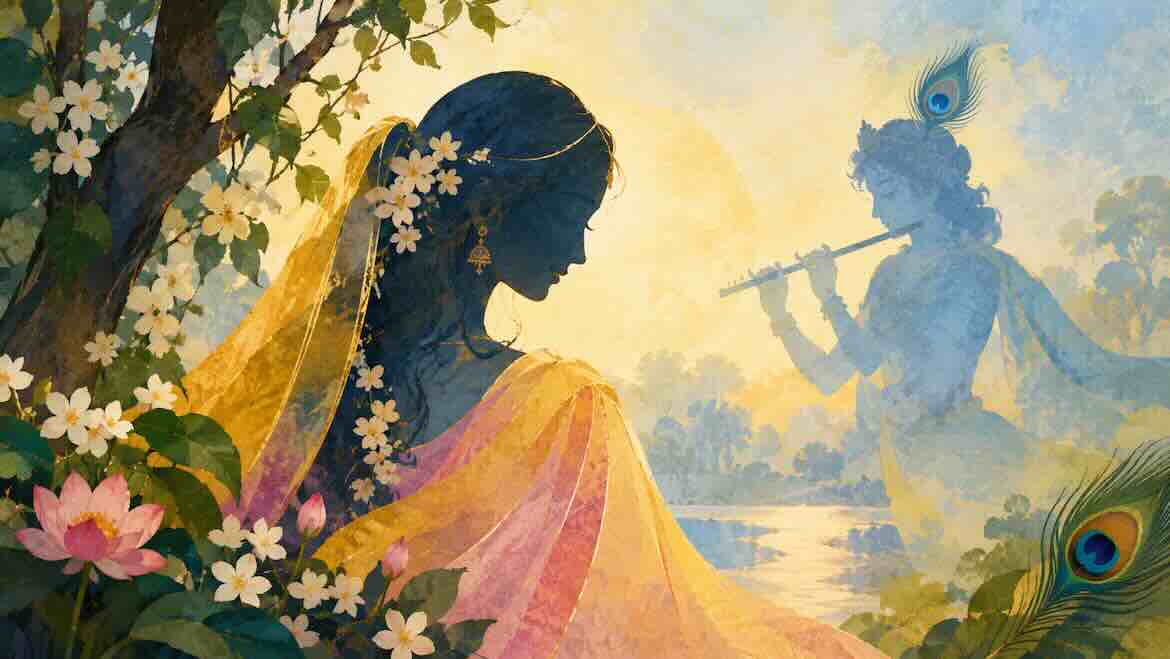
Different texts preserve different details of this event. The Garga Samhita describes Radha as a divine child received by Vrishabhanu. Later devotional traditions add the beautiful story of Vrishabhanu finding the infant Radha on a golden lotus near the Yamuna. Another beloved tradition says that baby Radha kept her eyes closed until infant Krishna was brought before her. She then opened her eyes and looked at Krishna for the first time. These details are deeply cherished, but they should be understood as belonging to particular devotional traditions rather than being presented as one identical account found in every scripture.
The Brahma Vaivart Purana presents another dimension of the story. There, Radha is described as eternally existing with Krishna in Goloka and as manifesting from Krishna's divine nature. Her descent to the earthly world is connected with the story of a curse involving Shridama, explaining why Radha and Krishna experience separation in their earthly pastimes.
Interestingly, the Bhagavat Purana, one of the most important texts about Krishna, does not explicitly use the name Radha. In 10.30.28, the gopis speak of one particular gopi whom Krishna had taken away with him, saying that she must have worshipped Krishna perfectly. Later Vaishnav commentators identify this beloved gopi with Radha.
Thus, Radha Ashtami is more than a celebration of a birthday. It honours Radha as the embodiment of love and complete dedication to Krishna.
Did You Know?
- Radha Ashtami falls on Bhadrapad Shukla Ashtami, about fifteen days after Krishna Janmashtami.
- Vrishabhanu is traditionally regarded as Radha's father.
- Different traditions give different names for her mother, including Kalavati and Kirti/Kirtida.
- Some traditions associate Radha's birthplace with Raval, while others identify Barsana. Barsana is today the place most strongly associated with her birth celebrations.
- The Bhagavat Purana does not directly name Radha, although later commentators identify her with the specially favoured gopi in its Rasalila narrative.
Why It Matters
Radha's story teaches that devotion is not about possession or personal gain. It is about love that rises above ego and expectation.
Her place in the Bhakti tradition reminds us that genuine love can involve humility and the willingness to put another before oneself. This is why Radha remains much more than a character in an old story. For millions of devotees, she represents the highest expression of loving devotion.
References
- Garga Samhita, Goloka Khanda 1, Chapter 8: Description of Shri Radhika's Birth. The principal textual account of Radha's birth in Braj.
- Shrimad Bhagavat Purana, Skandha 10, Chapter 30, Verse 28: The gopis describe the unnamed gopi whom Krishna takes away, a passage later Vaishnav commentators associate with Radha.
- Brahma Vaivart Purana, Krishna Janma Khanda: Contains extensive theology and narratives concerning Radha and Krishna, including Radha's eternal relationship with Krishna.
- Gita Govinda by Jayadeva: Medieval Sanskrit devotional poetry that places Radha and Krishna at the centre of an influential tradition of Krishna-bhakti.