Quick Answer
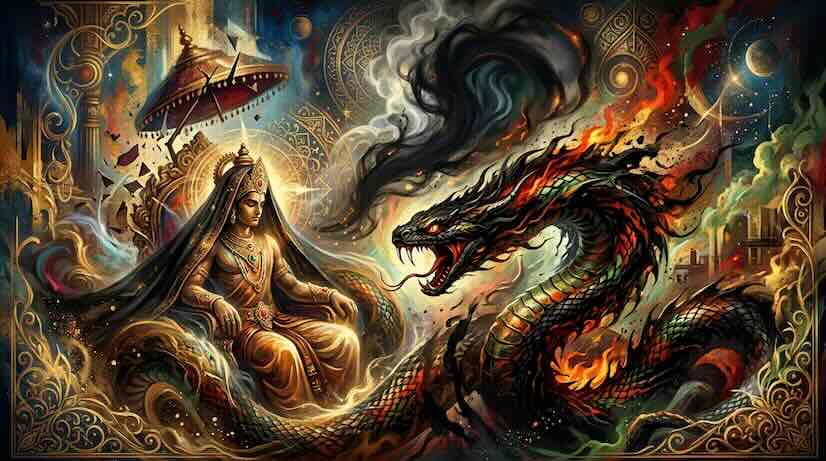
Takshak, the king of serpents, bit King Parikshit because of a curse given by Shringi, the son of sage Shamik. The curse was the result of Parikshit's disrespectful act towards the sage, and Takshak became the instrument through which the curse was fulfilled.
The Story
King Parikshit, the grandson of Arjun and the last great ruler of the Kuru dynasty, was known as a capable and righteous king. One day, while hunting in the forest, he became exhausted and thirsty. Searching for water and rest, he reached the hermitage of sage Shamik.
The sage was deep in meditation and did not respond to the king's requests. Feeling ignored and overcome by anger, Parikshit made a mistake. He placed a dead snake around the sage's neck with the tip of his bow as an act of frustration.
When Shringi, the sage's young son, learned about this insult to his father, he became furious. Using his spiritual power, he cursed Parikshit that within seven days, the serpent king Takshak would bite him, causing his death.
After learning about the curse, King Parikshit did not ignore his fate. He made every possible effort to protect himself during the remaining seven days. A special palace was prepared with strict security, and guards were placed everywhere to prevent any serpent from reaching him. He also surrounded himself with learned people like Sage Shuk and spent his final days listening to spiritual teachings. Sage Shuk narrated the greatness of the Divine and the path of liberation. This conversation became the foundation of the Bhagavat Purana tradition.
As the seventh day arrived, Takshak set out to fulfil Shringi's curse. Takshak used his powers of disguise and strategy to reach King Parikshit. On his way, he encountered the sage Kashyap, who was travelling to save the king from the serpent's poison. Kashyap possessed the knowledge to neutralise the effects of snake venom. However, Takshak demonstrated his own power and convinced Kashyap to turn back.
Later, Takshak entered the protected palace in disguise. In some retellings, he reached the king through a group of Brahmins carrying offerings, while hiding his true identity. Once he came close to Parikshit, he revealed his serpent form and bit the king. Despite all the precautions taken, the curse was fulfilled, and King Parikshit's earthly life came to an end.
Did You Know?
- After Parikshit's death, his son Janamejaya became king. Filled with anger towards the Nagas, he performed the Sarpa Satra.
- Janamejaya Sarpa Satra witnessed the dialogue between sages and kings, preserving many important teachings of Indian tradition.
Why It Matters Today
The story highlights the importance of controlling anger and understanding the consequences of our actions. It also shows that revenge can create endless cycles of suffering, while wisdom and forgiveness can restore balance.
References
- Mahabharat
- Adi Parva (Astika Parva, sections describing King Parikshit's curse, Takshak's bite, and Janamejaya's Sarpa Satra)
- Bhagavat Purana
- Skandha 1, chapters 18-19 (Parikshit's curse and his final days listening to Sage Shuk)
- Bhagavat Purana
- Skandha 12 (continuation of the lineage and teachings)