Quick Answer
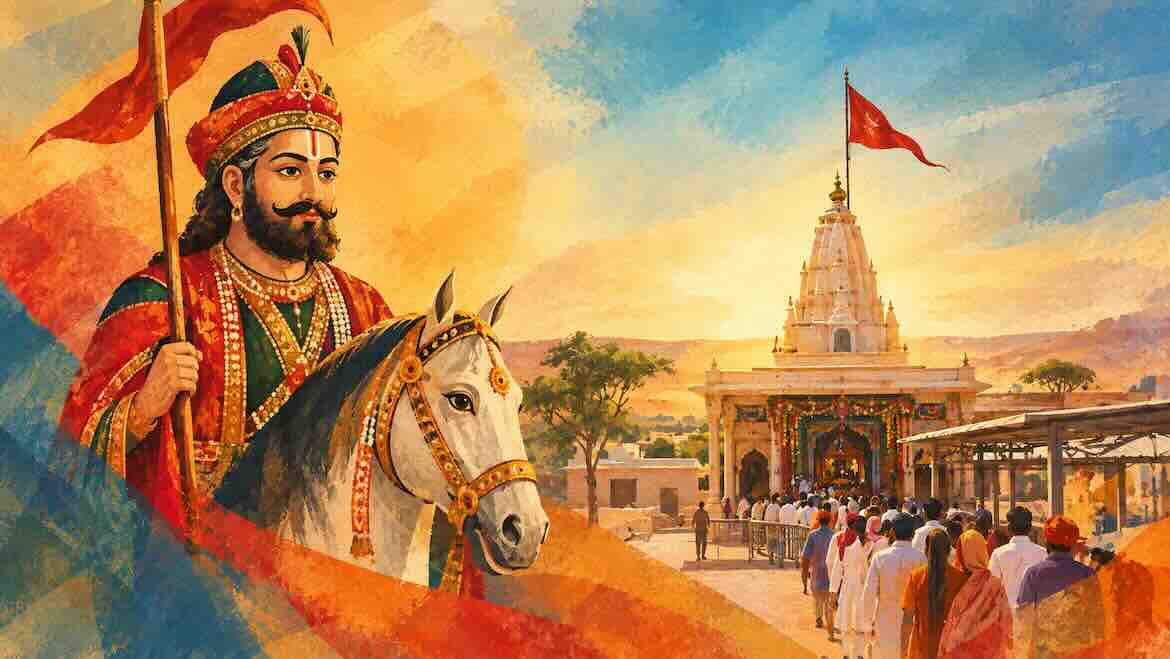
Baba Ramdevji was a medieval saint and folk deity of Rajasthan, traditionally associated with the Tanwar Rajput lineage. He is remembered for helping the poor and challenging social discrimination. Hindus revere him as a divine figure associated with Krishna, while many Muslims honour him as Ramsha Pir.
His samadhi at Ramdevra, near Pokhran in Jaisalmer district, is one of Rajasthan's important pilgrimage centres.
The Story
According to the Rajasthan Government's Ramdevji Panorama, Baba Ramdevji was born in Vikram Samvat 1409, approximately 1352 CE. The same source gives his birth as Chaitra Shukla Panchami. His father, Ajmalji, belonged to the Tanwar lineage, while his mother was Mainadevi. His birthplace is traditionally associated with the Undu-Kasamer region of present-day Barmer.
There is, however, some variation in traditional accounts. A Rajasthan Devasthan Department report gives his birth as Bhadrapad Shukla Dwitiya of Vikram Samvat 1409.
Ramdevji's birth itself is surrounded by a powerful legend. According to tradition, his father Ajmalji had remained childless and travelled to Dwarka to pray to Lord Dwarkadhish for a son. The Lord promised to be born as his child. Ajmalji subsequently had two sons, Veeramdev and Ramdevji.
From childhood, stories of Ramdevji's extraordinary powers began to spread.
One famous legend concerns a cloth horse. As a child, Ramdevji wanted to ride a horse. His mother asked a tailor to make one for him from cloth. When Ramdevji sat on it, the cloth horse flew into the sky. The tailor was accused of sorcery and imprisoned. Soon afterwards, Ramdevji was seen playing in the courtyard, with the same cloth horse beside him. The tailor was then released. This became one of the earliest famous miraculous manifestations associated with Ramdevji.
Another major legend tells of Bhairav, a powerful demon who was troubling the region. Ramdevji encountered the problem while visiting the ashram of the sage Balinath. He pursued Bhairav and eventually killed him on a hill. The story is remembered as an important example of Ramdevji's courage and supernatural power.
Another famous episode is the story of the five Pirs who came from Mecca to test Ramdevji's spiritual powers. The five Pirs planted their datuns, or chewing sticks, in the ground, and they miraculously grew into flourishing peepal trees. They then accepted Ramdevji's invitation to eat, but said that their eating vessels had been left behind in Mecca. Ramdevji is said to have caused those vessels to appear before them.
Impressed, the five Pirs accepted Ramdevji's spiritual greatness and honoured him as Ramsha Pir, meaning a Pir among Pirs. This story became an important part of the tradition through which Ramdevji came to be revered by both Hindus and Muslims.
Ramdevji later married Netalde, the daughter of Dalji Sodha of Amarkot. Traditional stories also associate Netalde with miraculous events and portray her as an important figure in Ramdevji's spiritual journey.
Ramdevji became known not simply as a warrior or ruler, but as a spiritual figure who stood with people facing social discrimination. Dali Bai, traditionally regarded as his spiritual sister, became an important part of this tradition. His followers remember him for treating people from different communities with dignity and equality. His tradition became especially important among communities that historically faced social exclusion.
According to the Rajasthan Government's Ramdevji Panorama, Ramdevji took jeevit samadhi at Ramdevra on Bhadrapad Shukla Ekadashi of Vikram Samvat 1442, approximately 1385 CE, at an age of about 33 years. This creates a traditional chronology of roughly Vikram Samvat 1409 to 1442, or approximately 1352-1385 CE.
However, another Rajasthan Board source gives 1458 CE for his samadhi.
A major shrine subsequently developed around his samadhi. The Rajasthan Devasthan Department states that the present temple was constructed in 1931, under the patronage of Maharaja Ganga Singh of Bikaner.
Every year, the Ramdevra Fair held around Bhadrapad attracts huge numbers of devotees. Kirtans and folk performances fill the pilgrimage centre, while people from different communities travel to Ramdevra to seek blessings and honour Baba Ramdevji.
Did You Know?
- Ramdevra is sometimes mistaken for a temple dedicated to Lord Ram because of its name. It is actually the principal shrine of Baba Ramdevji, the Rajasthani folk saint.
- Devotees also worship Ramdevji's pagliye, or sacred footprints. Shrines associated with these footprints can be found in villages across Rajasthan.
Why It Matters
Ramdevji's story shows that Indian culture has been shaped not only by major scriptures, but also by local saints and folk heroes whose stories became part of everyday life.
The miracle stories can be understood as expressions of faith and oral tradition, while the historical tradition remembers Ramdevji as an important medieval figure of Rajasthan.
His most enduring legacy is the idea that devotion should not become a reason to divide people. That is why Ramdevra is more than a pilgrimage destination.
References
- Rajasthan Government, Lokdevta Ramdevji Panorama, Rajasthan Heritage Protection and Promotion Authority. (jkk.artandculture.rajasthan.gov.in)
- Rajasthan Board, History and Culture of Rajasthan. (rajeduboard.rajasthan.gov.in)
- Rajasthan Devasthan Department, Temple Profile: Mandir Shri Ram Dev Ji. (devasthan.rajasthan.gov.in)
- Rajasthan Government, Development and Management Plan for Temple Complex and Settlement for Ramdevra. (devasthan.rajasthan.gov.in)
- Rajasthan Tourism, Jaisalmer and Ramdevra Temple. (tourism.rajasthan.gov.in)