Quick Answer
Ram received a vast collection of divyastras primarily from Sage Vishvamitra during his journey with him in the Valmiki Ramayan. After Ram killed Tadaka (Tataka), Vishvamitra taught him the mantras for invoking and withdrawing many divine weapons.
Later, during his exile, Sage Agastya also gave Ram important divine weapons, including a celestial bow and inexhaustible quivers.
The Story
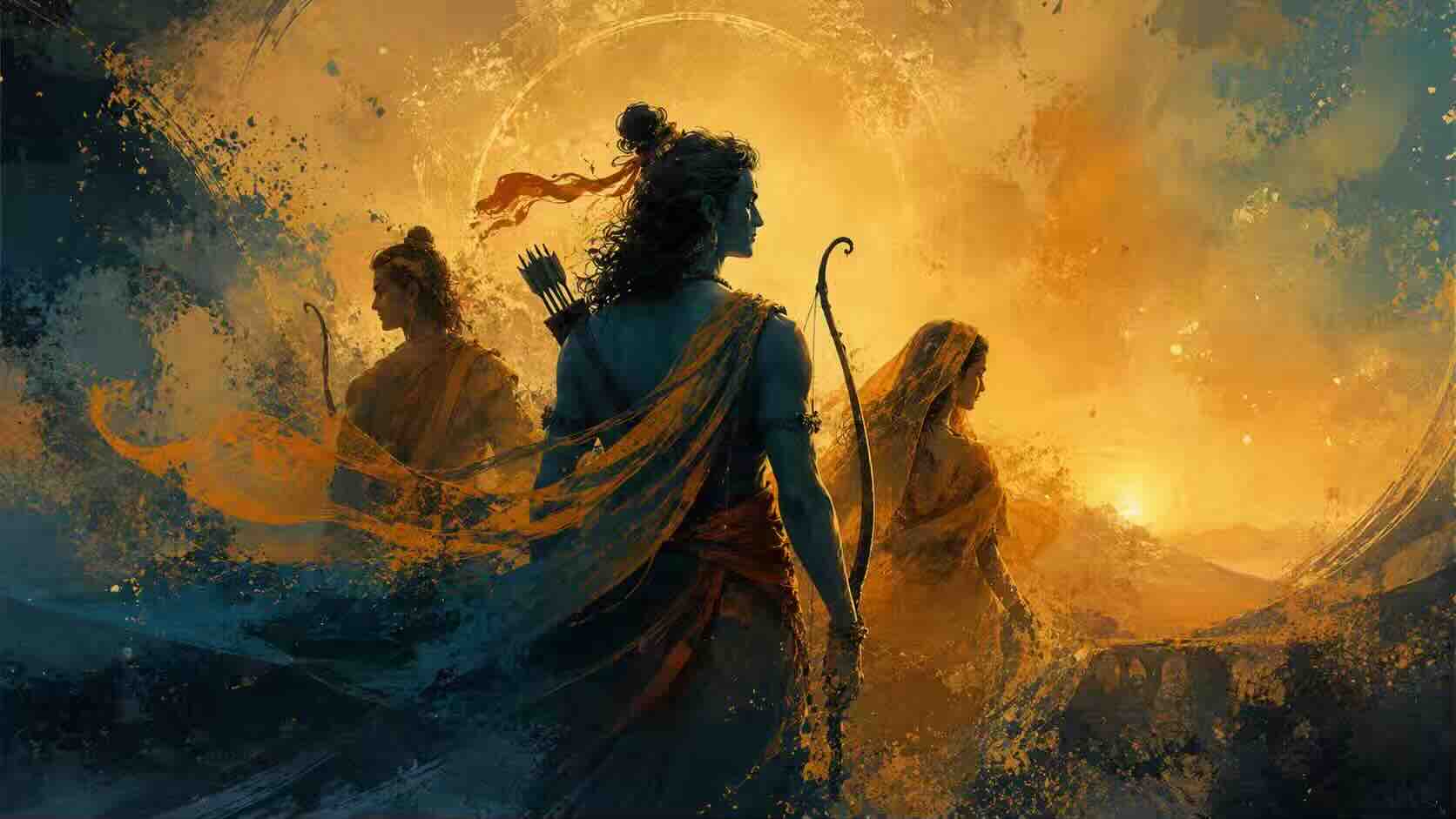
When Vishvamitra asked King Dashrath to send Ram and Lakshman with him to protect his yajna, the young princes began their journey with the sage. Near the Sarayu, Vishvamitra first taught them the powerful Bala and Atibala mantras. These helped them withstand fatigue and hunger.
Their first major test came in the forest of Tadaka. Ram defeated Tadaka after Vishvamitra instructed him to protect the sages and their sacred activities. Pleased with Ram's discipline and obedience, Vishvamitra then gave him something far more powerful.
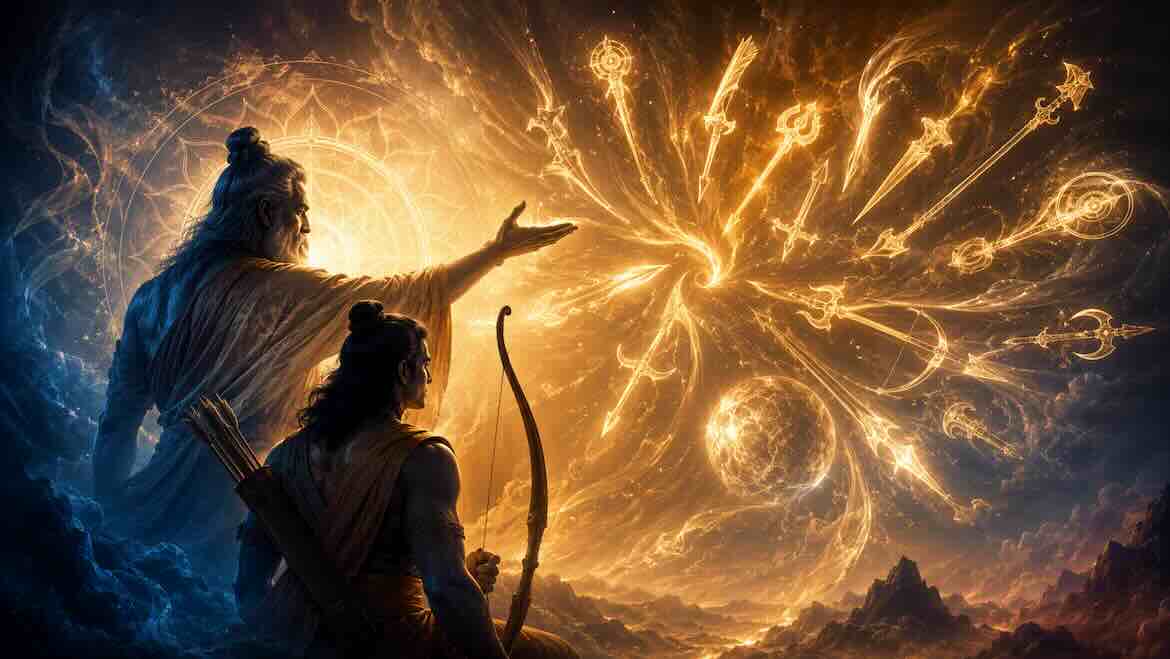
The next morning, Vishvamitra presented Ram with a vast collection of divine astras and their associated mantras. Among the important weapons named are the Brahmastra, Brahmashira, Aishika, Shiva's Trishul, Vishnu's Chakra, Indra's Vajra, Dharma Chakra, Kala Chakra, Vayavya Astra, and various Pashas (nooses).
An astra was not merely a physical weapon. According to the text, it was associated with a deity or divine power and was activated through its prescribed mantra. Vishvamitra therefore taught Ram not only how to invoke these weapons but also how to withdraw or neutralise them. Ram specifically asked for this knowledge, and Vishvamitra taught him the methods.
The weapons themselves are described as appearing in personified, radiant forms and offering their service to Ram. He accepted them and instructed them to appear whenever he summoned them.
Ram later demonstrated this training at Vishvamitra's yajna. He used a Manava Astra against Maricha and an Agneya Astra against Subahu, showing that the weapons were meant to be used with precision rather than recklessly.
Much later, during his exile, Ram met Sage Agastya, who gave him further celestial weapons, including Vishnu's bow and inexhaustible quivers.
Did You Know?
- Brahmastra and Brahmashira are distinct weapons in the Valmiki Ramayan; they are not simply two names for the same astra.
- The Valmiki Ramayan describes many astras as having personified forms, showing that they were understood as more than ordinary physical weapons. In Dashrath's court, Maharshi Vasishtha explains that all the hundred divyastras are the children of Krishashva and Jaya and Suprabha, the daughters of Prajapati Daksha.
- The detailed account of Bala, Atibala and Vishvamitra's extensive list of astras is found in the Valmiki Ramayan; the Ramcharitmanas presents this part of the story much more briefly.
Why It Matters Today
The story offers a simple lesson: knowledge must come before power. Ram first learned discipline and proved his ability to act responsibly. Only then was he entrusted with extraordinary weapons.
The deeper message remains relevant today. Whether the power is technology, money, authority or knowledge, possessing it is less important than knowing when and how to use it responsibly.
References
- Valmiki Ramayan
- Bal Kand, Sarga 22: Vishvamitra teaches Ram and Lakshman the Bala and Atibala mantras.
- Bal Kand, Sargas 24-26: Tadaka's story, Ram's encounter with her, and the events leading to the granting of divine weapons.
- Bal Kand, Sarga 27: Vishvamitra gives Ram the divine astras and their mantras.
- Bal Kand, Sarga 28: Ram learns the methods of invoking and withdrawing the astras.
- Aranya Kand, Sarga 12: Ram's meeting with Agastya and the divine weapons presented to him; the tradition includes Vishnu's bow and inexhaustible quivers.
- Ramcharitmanas
- Bal Kand: Tulsidas narrates Vishvamitra's taking of Ram and Lakshman and their protection of the yajna, but does not provide the extensive weapon-by-weapon catalogue found in Valmiki's account.