Quick Answer
According to the Valmiki Ramayan, King Dashrath of Ayodhya had no children despite having three queens, Kausalya, Kaikeyi, and Sumitra. On the advice of his councellers, the great sage Rishyashringa performed the Ashvamedha Yajna, followed by the Putrakameshti (Putreshti) Yajna, a Vedic sacrifice conducted for the blessing of worthy offspring. At the conclusion of the yajna, a divine being emerged from the sacrificial fire carrying a bowl of sacred payasam (sweet pudding). Dashrath distributed it among his queens, leading to the births of Ram, Bharat, Lakshman, and Shatrughna.
The Story
King Dashrath was a powerful and respected ruler, but the absence of an heir troubled him deeply. Concerned about the future of the Ikshvaku dynasty, he sought guidance from Sage Vasishtha and his prime minister, Sumantra, who recommended inviting Sage Rishyashringa to perform the Putrakameshti Yajna.
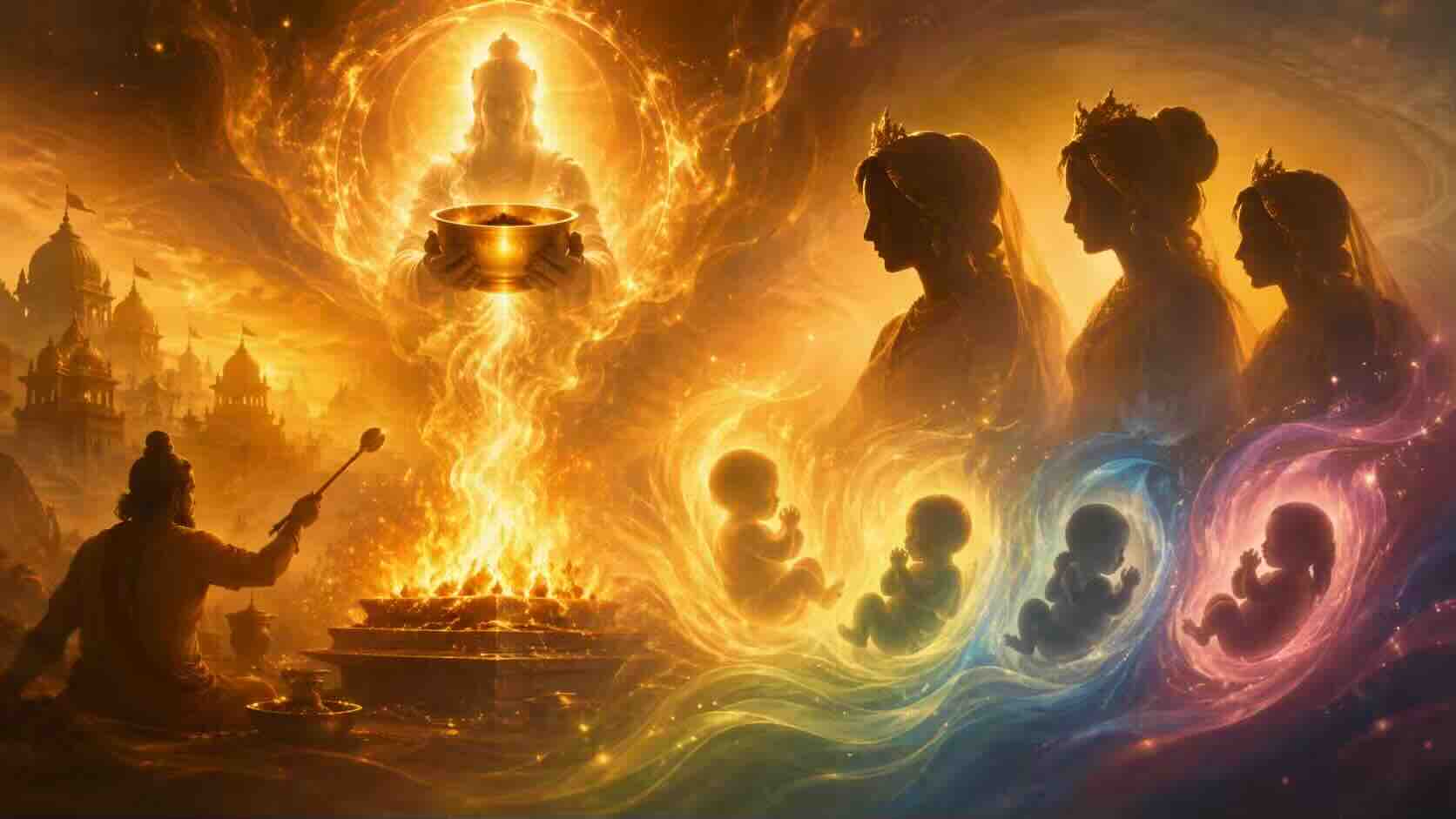
Following the completion of the Ashvamedha Yajna, Sage Rishyashringa conducted the Putrakameshti Yajna with great precision according to Vedic traditions. When it concluded, a radiant celestial being arose from the sacred fire carrying a golden vessel filled with divine payasam. The being instructed Dashrath to distribute it among his queens.
Dashrath first gave half of the payasam to Queen Kausalya. Of the remaining half, one portion went to Queen Sumitra and another to Queen Kaikeyi. The remaining payasam was again given to Sumitra.
In due course:
- Kausalya gave birth to Lord Ram, regarded as the seventh incarnation of Lord Vishnu.
- Kaikeyi gave birth to Bharat.
- Sumitra gave birth to Lakshman and Shatrughna, the twin princes.
Some traditions also explain the close bond between Ram and Lakshman, and between Bharat and Shatrughna through the way the sacred payasam was distributed among the queens.
Did You Know?
- The Putrakameshti Yajna is a Vedic ritual specifically performed with the wish for virtuous children.
- Sage Rishyashringa was chosen because of his exceptional spiritual purity and mastery of Vedic rituals.
- Lakshman and Shatrughna were born as twins to Queen Sumitra.
- The birth of the four princes takes place in the opening chapters of the Bal Kand of the Valmiki Ramayan.
Why It Matters Today
The story shows how patience and right action, guided by wisdom, can shape the future. It also reminds us of the importance of family and duty. The four brothers later became lasting examples of loyalty and sacrifice for one another.
References
- Valmiki Ramayan
- Bal Kand, Sargas 14-18 (King Dashrath's desire for heirs, Putrakameshti Yajna, distribution of the divine payasa, and birth of the four princes)
- Ramcharitmanas
- Bal Kand (Description of the Putrakameshti Yajna and the divine birth of Lord Ram and his brothers)
- Vishnu Purana
- Book 4 (Genealogy of the Solar Dynasty and the divine incarnation of Lord Vishnu as Ram)