Quick Explanation
FASTag detects your vehicle using RFID (Radio Frequency Identification) technology. A small sticker attached to your vehicle's windshield contains a unique identification number. When your vehicle approaches a toll plaza, a reader installed above the lane sends radio signals to the FASTag. The tag responds with its unique ID, and the toll amount is automatically deducted from the linked bank account or wallet.
Think of it like a contactless metro card, except you do not need to stop and tap it manually. The toll system reads it while the vehicle is moving slowly through the lane.
How It Works
Here is the process in simple steps:
- FASTag sticker is fixed on the windshield.
- A scanner at the toll plaza emits radio waves.
- The FASTag receives the signal and sends back its ID.
- The toll system checks the linked account balance.
- The toll amount is deducted automatically.
- The barrier opens, and the vehicle passes through.
The entire exchange usually takes less than a second.
A useful analogy is a barcode scanner in a supermarket. The cashier scans the barcode to identify the product. Similarly, the toll reader scans the FASTag to identify the vehicle and process payment instantly.
What Is Inside the FASTag Sticker?
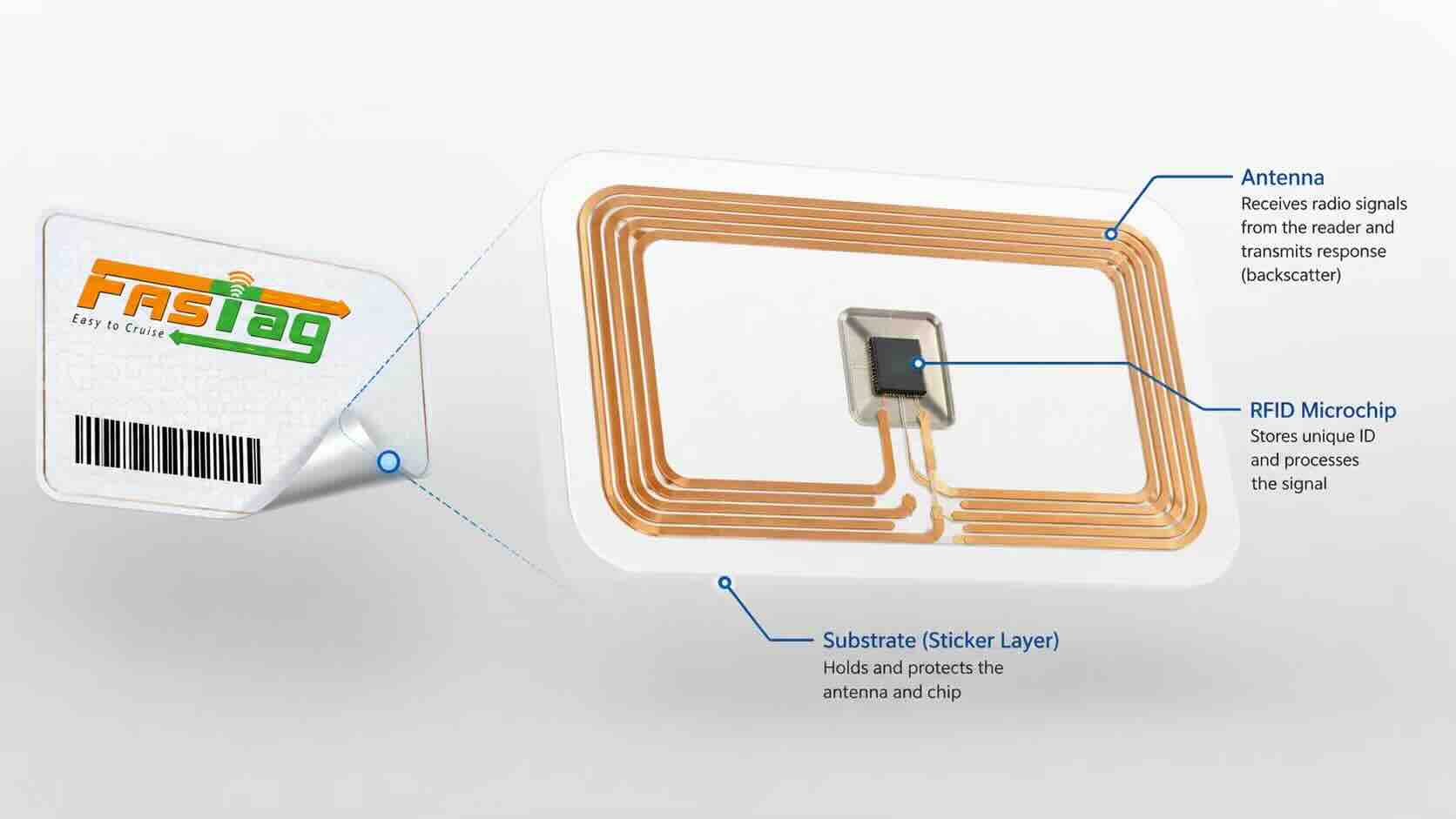
Many people wonder how a thin paper-like sticker can communicate with a toll plaza. FASTag is actually a smart RFID label. Inside the sticker is a tiny microchip connected to a very thin metal antenna printed or embedded within the layers of the sticker.
- The antenna acts as the receiver, capturing radio waves sent by the toll plaza reader.
- The captured energy powers the microchip for a brief moment.
- The chip then sends back its stored unique identification number through the same antenna, which now acts as the transmitter.
This is why FASTag does not need a battery. The toll reader provides the energy required for communication. You can think of it like a solar calculator that works when light falls on it, except FASTag works when it receives radio energy from the toll scanner.
So, although FASTag looks like an ordinary windshield sticker, it contains a miniature electronic system that combines receiving, processing, and responding functions within a single lightweight label.
Why It Matters
FASTag is not just about convenience; it has wider benefits for the country.
- Reduces traffic congestion at toll plazas.
- Saves fuel by reducing idling time.
- Cuts travel time on highways.
- Encourages digital payments and reduces cash handling.
- Creates accurate toll records for better highway management.
For daily commuters, commercial vehicles, and long-distance travellers, these small time savings add up significantly. FASTag shows how a simple RFID sticker, combined with digital payments and highway infrastructure, can make transportation faster, cleaner, and more efficient across the country.