
Contemporary Fiction Corporate Fiction Technology Slice of Life

Gurgaon Code

A Day of a Software Engineer

"A single workday. Countless invisible battles."

A sharp, emotionally grounded corporate drama set entirely within the rhythm of one tense day. Explore the unseen emotional labor, office politics, and deadlines that define the tech workspace in modern India.

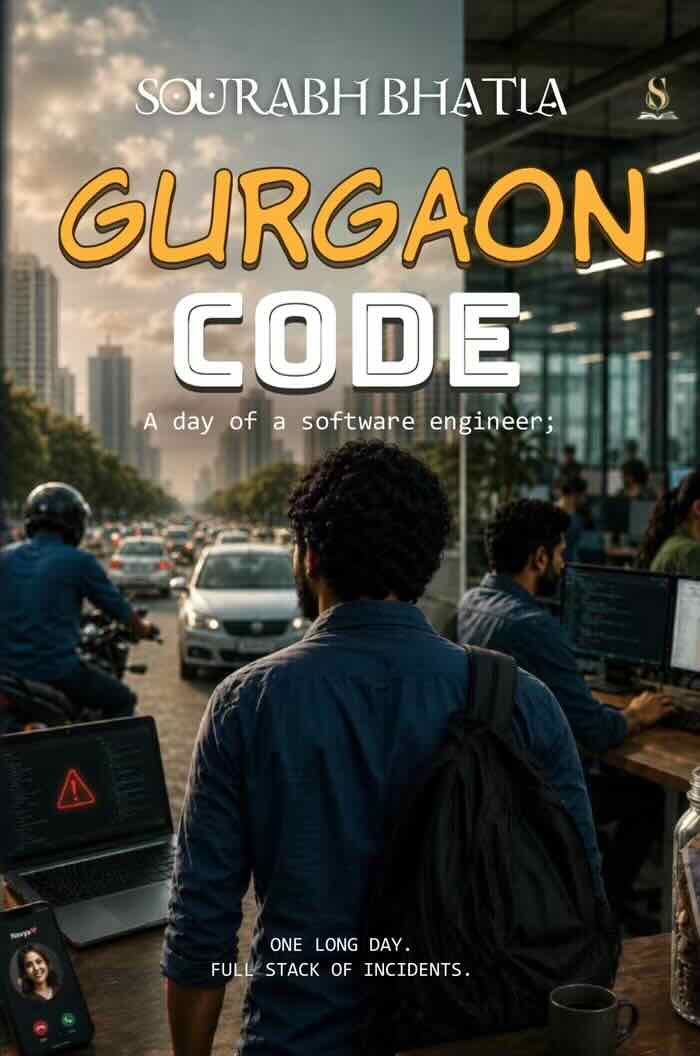
Front cover of Gurgaon Code novel showing high-rise office towers
Front Cover
Back cover placeholder
Back Cover

Before You Read

Every software engineer in India has lived this story. Before you open the first page of Gurgaon Code, let's establish what this novel is, and what it represents.

  • This isn't a thriller about cyber conspiracies.
  • This isn't a startup success story filled with VC funding clichés.
  • This isn't a tale of billion-dollar founders and instant wealth.
  • It is the story of one ordinary workday that quietly mirrors the struggles, jokes, and dreams of millions of software developers in India.

At a Glance

Title Gurgaon Code
Genre Contemporary / Corporate Fiction
Setting Cyber City, Gurgaon, India
Timeline One unforgettable workday.
Language English
Formats Paperback, Kindle, eBook
Reading Time Approx. 4-5 hours
Themes Burnout, Office Politics, Friendship

About the Novel

In the heart of India's technology hub, where towering glass facades reflect the dusty skies of Haryana, millions of developers log in every morning to run the digital machinery of the world. Gurgaon Code is a contemporary corporate fiction novel that captures the essence of this modern landscape, telling the story of one software engineer navigating a single, high-stakes workday. Far from corporate slogans and startup marketing hype, this novel explores the raw, human side of the technology industry. It is a slice-of-life workspace drama that examines the silent pressures, everyday rituals, and unseen compromises made in the pursuit of career growth.

The story begins with the jarring ring of an early morning alarm. Waking up in a shared flat, the protagonist prepares to face the daily commute. Stepping onto the seat of a Bajaj Pulsar, they join the ocean of vehicles navigating the chaotic Gurgaon traffic. The journey itself is a metaphor for the developer's life—navigating potholes, dust, and aggressive drivers just to arrive at a desk. By the time they enter the office, the physical exhaustion is met by the mental preparation for the first ritual of the day: the daily stand-up meeting.

Standing in a semi-circle, the team gathers around the Jira board. For a software developer, this board is both a tracker and a source of silent anxiety. Here, tasks are broken down into tickets, and delays are public knowledge. We meet Navya, a senior developer carrying the weight of legacy code and pending refactoring, and Ankit, a fresh graduate struggling to decode complex enterprise modules while trying to mask his confusion. The engineering manager facilitates the meeting, balancing corporate metrics against the visible signs of team fatigue. In this space, office politics are played out in subtle code reviews, passive-aggressive Slack comments, and the distribution of technical debt.

The fragile peace of the morning is shattered when a critical production support alert is triggered. The client's application has crashed, halting transactions. The incident is classified as a P1 incident, sending waves of panic through the management chain. Suddenly, the focus shifts to debugging. The team is gathered in a war room, scouring logs, arguing over recent deployments, and attempting to write a hotfix. The manager is under constant escalation calls, while the QA engineer works under extreme pressure to validate the patch. It is in these tense hours that the reality of IT job pressure and corporate burnout becomes concrete. The code is no longer an abstract logic path; it is a ticking clock directly linked to financial loss and personal reputation.

Midway through the crisis, the team is required to attend a company-wide townhall. In a brightly lit auditorium, corporate leaders present slides on synergy, innovation, and long-term vision. The contrast is stark—leaders talk of work-life balance and creative freedom, while the developers in the back row are checking production servers on their phones, worrying about the unresolved bug. Following the townhall, a quick, quiet lunch at the office cafeteria provides a brief window to discuss salary structures, appraisal systems, and the rising costs of rents and home loans in Gurgaon.

As the afternoon progresses, a sudden security investigation adds a new layer of tension. A potential compliance leak or source code access issue is raised, forcing the developers to defend their actions, exposing the vulnerability of individual careers in a highly standardized corporate system. Yet, through the stress, the bonds of friendship keep the team together. Whether sharing a smoke break on the terrace or helping each other review code, these relationships provide a vital coping mechanism against systemic pressure.

By evening, after multiple cycles of testing and deployment, the hotfix is successfully released to production. The red alerts on the dashboards turn green, and the war room empties. To wind down, the protagonist and their roommate head to a local Gurgaon BYOB (Bring Your Own Beer) place. Under the neon lights, over cold drinks and loud music, the conversations shift to personal aspirations, family commitments, and the search for identity beyond a software developer salary. It is a moment of raw honesty, where the corporate masks are dropped.

However, the day does not end in quiet resolution. Returning home, an unexpected twist waiting in the inbox changes the protagonist's outlook, reminding them that inside the corporate machine, some ordinary workdays refuse to stay ordinary. Gurgaon Code is a tribute to the silent endurance of India's tech workforce. It is a story of codes, bugs, and the human hearts that run them.

Inside This Story

Corporate Chaos

Navigating complex hierarchies, constant client demands, and shifting business priorities.

Morning Traffic

The daily battle on Gurgaon's roads, battling dust and deadlines on a Pulsar.

Stand-up Meetings

The daily 15-minute updates where developers try to sound busy on the Jira board.

Production Bugs

The high-pressure search for errors in real-time when the system is down.

Deadlines

The invisible timelines that govern weekends, evenings, and personal plans.

Friendship

The shared jokes and terrace smoke breaks that make corporate survival possible.

Marriage & Family

Balancing parental expectations, arrange-marriage profiles, and home loans.

Career Anxiety

The fear of falling behind in tech stacks, appraisal ratings, and salary hikes.

Meet the Characters

💻

The Protagonist

A mid-level developer trying to balance production bugs against family pressures.

👩‍💻

Navya

A senior developer carrying the weight of complex legacy systems and code reviews.

👔

Vivek

The engineering manager caught between client demands and team burnout.

🧑‍🎓

Ankit

The fresh graduate trying to find his footing amidst technical terms and Jira boards.

🏠

The Roommate

The flatmate who works in sales and provides a different look at corporate life.

🔍

QA Engineer

The tester whose approval is required before code is released to production.

📞

The Client

The distant, demanding stakeholder whose escalations drive the team's schedule.

🕵️

Security Lead

The investigator checking access logs, adding tension to an already long day.

A Day in Gurgaon

Alarm 07:00 AM
Traffic 08:30 AM
Stand-up 10:00 AM
P1 Bug 11:30 AM
Townhall 01:00 PM
Lunch 02:00 PM
Security Check 03:30 PM
Bug Fix 06:00 PM
BYOB Night 08:30 PM
The Twist 11:00 PM

Core Themes

Corporate Pressure

The psychological impact of endless sprints, reviews, and client calls.

Identity & Tech

Finding meaning when your daily life is governed by tickets and logs.

Friendship

How shared support networks provide relief in high-pressure workspaces.

Burnout

The gradual physical and emotional wear of the corporate IT environment.

Who Will Relate to This Book?

You work in IT.

You understand Stand-ups, Code reviews, and the dread of appraisal seasons.

You have fixed production bugs.

You know the stress when logs are printing errors and the team is waiting.

You support your family.

You balance home loans and personal responsibilities against corporate life.

You dream of work-life balance.

You feel nobody understands what software developers actually face day-to-day.

Corporate Glossary

A quick guide to the terminology of modern software engineering and agile corporate life in India:

Jira A project tracking tool used to assign tasks and trace developer output.
Sprint A fixed period of time (usually 2 weeks) during which specific tasks must be completed.
Stand-up Meeting A daily 15-minute status update meeting for Agile development teams.
P1 Incident A critical production outage requiring immediate resolution from support teams.
Technical Debt The cost of choosing quick code fixes now over clean design paths later.
CI/CD Continuous Integration/Continuous Deployment channels to build and test code.

Featured Excerpts

"The Jira board was a digital grid of commitments. Every ticket moved felt like a tiny victory, yet the backlog remained as infinite as the Gurgaon sky."
"In Cyber City, the office towers glowed in neat geometries. Inside, we debugged servers, while outside, the traffic on the highway remained locked in chaos."
"Over a cold drink at the BYOB, the code felt distant. We talked of EMIs, parental expectations, and who we actually were when the laptop screen went dark."

Frequently Asked Questions

Although Gurgaon Code is a work of fiction, the corporate settings, Agile rituals, and developer terminologies are inspired by the author's decade-long experience inside the Indian software industry.
Not at all. While software developers will immediately recognize their daily struggles, any corporate professional who has dealt with office politics, deadlines, demanding clients, or burnout will relate to the story.
Yes. The novel includes a helpful glossary of terms, and the focus is on the human relationships, office politics, marriage pressures, and personal dreams of the characters rather than dry technical jargon.
By compressing the timeline into one 24-hour cycle, the book captures the intense pressure, rapid transitions, and fast-paced environment of a typical corporate workday in Gurgaon.
It explores realistic relationship dynamics, including the pressures of finding a partner, coordinating marriage expectations, and maintaining work-life balance inside the high-stress IT sector.
Yes, it features sharp office humor and dry wit reflecting the coping mechanisms developers use to survive stand-ups, townhalls, and buggy deployments.
Yes, office politics, appraisal anxieties, credit-grabbing managers, and the delicate art of team dynamics form a core part of the plot.
Absolutely. Senior developers and leads will highly relate to the P1 bugs, production support stress, and code reviews, while managers will recognize the balancing act between client demands and team burnout.
Yes, it offers a realistic, unvarnished look at what awaits freshers entering the corporate tech space in India, preparing them for office dynamics beyond textbook coding.
Gurgaon is the perfect microcosm of modern corporate India, representing the contrast between ultra-modern glass offices, massive tech parks, traffic jams, and middle-class aspirations.
Extremely realistic. The Agile rituals, Jira tickets, client escalations, and lunchroom talks are written from years of direct observation in enterprise software setups.
Profile photo of Sourabh Bhatia

About the Author

Sourabh Bhatia is a software engineer and author with over a decade of experience building enterprise systems. Having worked directly inside Agile release teams, production support rooms, and client negotiations, his corporate stories reflect the authentic realities of software developers in modern India.

Bring Gurgaon Code to Your Shelf

Available globally in Paperback and Kindle formats.

Stay in the Circle

If stories about technology, work, and modern India resonate with you, subscribe for future books and articles.

Join the newsletter